Entradas

Decrecimiento o barbarie

Imagen
  En su ponencia para las jornadas “Otra economía está en marcha” de 2020, Jason Hickle apuntó correctamente que deberíamos replantearnos el término “antropoceno” para describir la era actual y usar en vez el término “capitaloceno.” El motivo de este matiz es que el término antropoceno, aunque resalta la importancia de la actividad humana en la situación actual del planeta, no señala que no es simplemente la actividad humana la que ha creado los problemas actuales de colapso ecológico, sino la actividad humana bajo un sistema económico particular: el capitalismo.   Yendo aun más allá, Hickle señalaba que, dentro de este sistema económico global, no todos los estados tienen la misma culpa, ya que son los estados ricos los que han causado la mayor parte del exceso de emisiones global, con el Norte Global causando el 92% de las emisiones de CO2 históricas. Mientras tanto, el Sue Global sufre el 90% de los costes y el 98% de las muertes derivadas del colapso ecológico. Este proc...

The Bracero Program and Mexican Indigenous Communities

‘In Modern Mexico… Indians would be productive citizens or be damned!’ Robert Buffington The assumption that indigenous communities were ‘unproductive’ and unfamiliar with ‘labor’ before their entry into the Bracero Program plays into long-standing narratives of indigenous racial deviancy, one that had to be corrected through state intervention. It is precisely this narrative that the Bracero Program used as it attempted to incorporate indigenous populations into the interconnected Mexican projects of modernization and mestizaje. The program was supposed to facilitate this inclusion, a promise of the Mexican Revolution, not through ‘costly state programs’ of land and wealth redistribution but through a system of labor management abroad, ‘reliev[ing] the [Mexican] state of this perceived burden’ (Loza p.9, 15). Inclusion was based on Mexican concepts of racial flexibility in which ‘being indigenous’ was a matter of culture that could be overcome through a ‘civilizing process.’ B...

Limitations of solely using economic theories to understand or determine the causes of migration

            Economic theories are fundamental for understanding the causes of migration. However, narrow understandings of self-regulating market mechanisms of supply and demand operating as ‘push-pull factors’ often present a limited framework to study migration, and legitimize policies that do not attend to the realities of migration. Gonzalez and Fernandez have provided a strong critique of push-pull theories in the context of Mexican migration to the U.S., arguing that a framework of imperial expansionism is better suited to explain patterns of migration since the late nineteenth century.  Guerin-Gonzales has also shown how, in the context of Mexican removal programs during the Great Depression, ‘voluntary’ deportations were officially justified under economic reasons, but were rooted in cultural prejudices and longstanding histories of racism and exclusion. Lastly, Molina’s study of birthright citizenship shows that mi...

Comparative Review: Benedict Anderson’s Imagined Communities and John Darwin’s After Tamerlane

Imagen
Nations and empires have, particularly since the late-eighteenth century, dominated the way we imagine the organization of the polity. Benedict Anderson’s Imagined Communities (1983) and John Darwin’s After Tamerlane (2008) provide nuanced accounts of these highly politicized concepts. Influenced by the historiographical context of their writing, they both attempt to expand and reimagine commonplace conceptions of nationalism and empire, each at a time when their respective unit of analysis was seen in reductionist terms . While Anderson focuses on nations as a source of identity, Darwin looks at empires as a source of power. Both complement each other in their efforts to help us understand globalization and the making of the modern global world order, in what international relations scholars would call constructivist (Anderson) and realist (Darwin) terms. Ultimately, in a ‘Chakrabartian’ spirit, they both contribute to ‘provincializing Europe’, widening our lens from an Euroc...

On Crenshaw

Imagen
'Intersectional subordination need not be intentionally produced' In her pioneering account of intersectionality, critical race theorist and activist Kimberlé Crenshaw proposed intersectionality as an account of intra-group difference, a way of 'mediating the tension between multiple identities and the necessity of group politics.' Different from antiessentialism, intersectionality recognises the significance of socially constructed categories and sees categorization as more than a one-way exercise of power. The problem for Crenshaw resides not in the existence of categories per se but rather in the particular values attached to them and the way those values create social hierarchies and strategic silences, sometimes unintentionally. For her, recognising the ways in which the intersectional experience of women of colour (woc) are marginalised in prevailing conceptions of identity politics does not require that we give up attempts to organise, but rather provide...

On Fanon

Imagen
'For it is the settler who has brought the native into existence and who perpetuates his existence'  In his analysis of colonialism and violence, Fanon drew from a diverse range of Western intellectual sources from Marx to Freud. His view of the settle-native dyad owes much however to Hegel's master-slave dialectic, looking at the many subtle ways in which racism and exploitation worked on the colonised and how he/she internalised the Western standards of value. The colonial world being a Manichean one, Fanon argued that the imposition of this military, political, economic, cultural and psychological subjugation of one people to another was only possible through violence. The violence in the ordering of the colonial world leads to separation and difference, and it is here that the settler-native dynamic comes into play. Colonialism is a system of domination that usually involves the transfer of population from the metropole to the colony. According to Fanon,...

On Beauvoir

Imagen
In her sophisticated philosophical account of gender, Beauvoir argues that normality, common sense, the 'norm' is male; but also everything that is positive. In opposition, femininity/womanhood is all that is negative. The implications are that a man never begins by positing himself as an individual of a certain sex, as his assertions shall not derive from this basic truth. Being a man is not seen as a particularity, as men are not seen to be constrained by their bodies. The opposite applies to women. In her theory of the 'Other,' inspired by Hegel's master-slave dialectic, Beauvoir sees women determined and differentiated in relation to men (but not viceversa). Women are defined as other, that is as lack of self, as inessential beings in from of the essential (men). Being female is defined as a failure to be a man. Although women sense this necessary link which connects them to men, they tends to make no claim for themselves as subjects, lacking the concrete ...

On MacKinnon

Este resumen no está disponible. Haz clic en este enlace para ver la entrada.

What did France try to achieve in Algeria?

Imagen
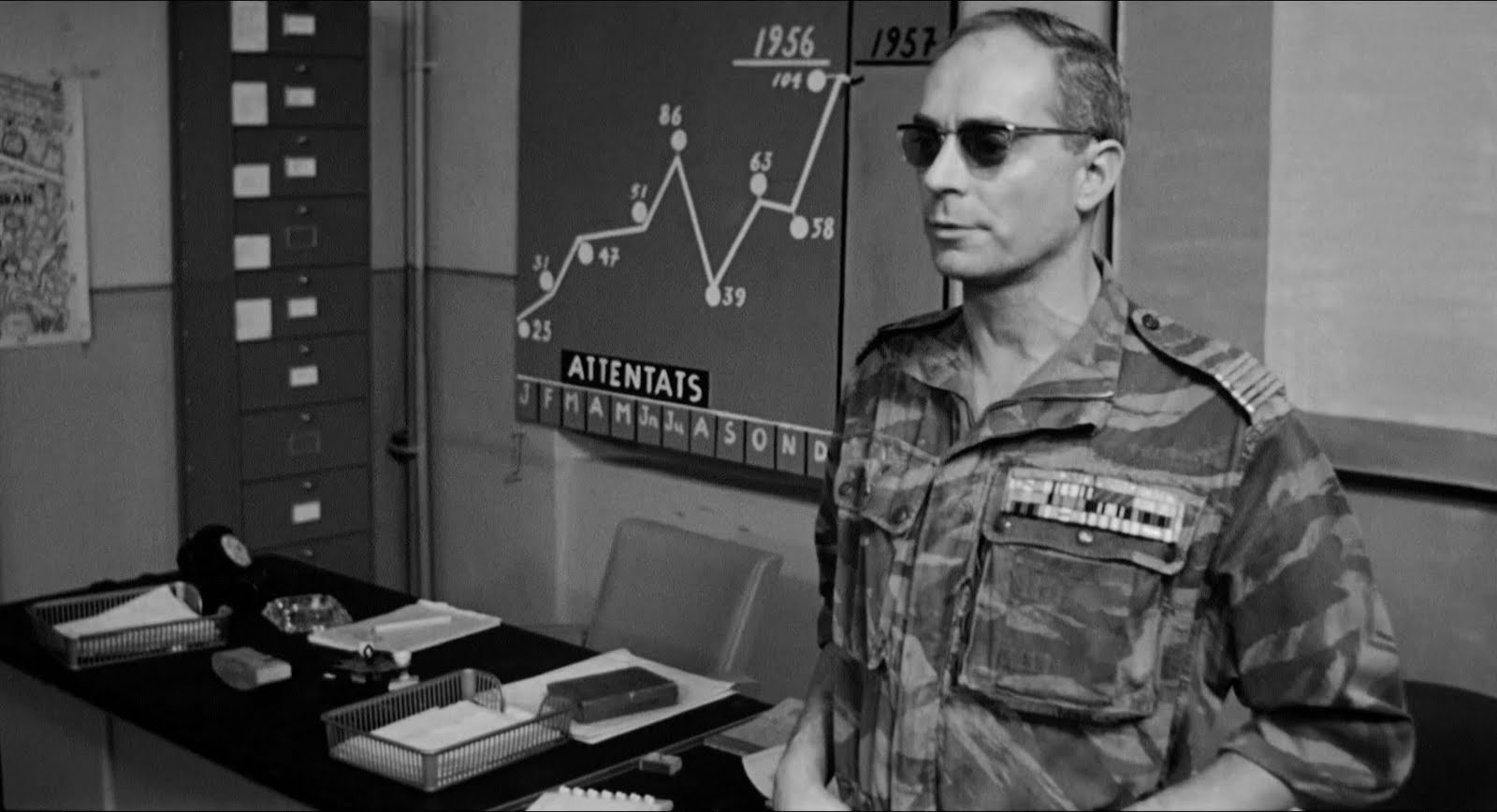
A shot from Battle of Algiers The French Empire has been conventionally seen as the most assimilationist of European Empires, and Algeria its most integral settler colony with almost one million French inhabitants in 1945. After its decline as a world power following the Second World War and the rise of anticolonial revolutions responding to the racism and state violence of events such as the Setif massacre in Algeria in 1945, France deployed a programme of forced modernization focused on social and economic planning, strategic resettlement and the 'emancipation' of women that combined military violence with 'development' and which unsuccessfully tried to achieve the transformation of the Algerian subject into a docile one that would fit with French plans for Algeria as an integral part of French territory, a continuation of France on the other side of the Mediterranean. Although some historians trace the start of the war back to French invasion in 1830, due ...

To what extent was the Vietnam War a 'Cold War' conflict?

Imagen
Dien Bien Phu (1954) The American involvement in Vietnam, starting during the Second World War in their fight against the Japanese and intensifying after the French defeat at Dien Bien Phu in 1954, was an important Cold War conflict, but the central analytical presence of the Cold War was not the only source of policy in Vietnam: other analytical narratives such as European colonialism , including themes of Western cultural superiority and racialised perceptions of the Vietnamese, are crucial to understanding key elements of the war such as American modernization theory, best exemplified through programmes such as the Strategic Hamlet Programme (1962-3) and Civil Operations and Revolutionary Development Support (CORDS) (1967-73). Strategic Hamlet Despite Roosevelt's call for the self-determination of peoples across the globe in the Atlantic Charter (1942) and the US collaboration with the Vietminh  during the Second World War, at his death in 1945 his successor Truman ...

To what extent did the theory and practice of European colonial planners and American modernization theorists overlap?

Imagen
While applauding the end of legal colonialism, American modernization theorists such as Rostow shared to large extent the theory and practice of European colonial planners, and Rostow himself saw colonialism as part of the transitional path to modernization. Sharing a similar view of modernity and development and an emphasis on self-image and cultural superiority clouded with Orientalist assumptions, both also shared an authoritarianism and recourse to violence for the 'greatest good,' although modernization theory had some peculiarities such as its distaste for formal direct rule or its increased focus on the social sciences and cultural over biological racism, the last two being borrowed by colonial planners after the Second World War to try to 'fit in' with the changing tide of history. Colonial planning after 1900s and modernization theory of the 1950s shared a similar belief in modernity, a human-centred (vs. God-given) process of increasing order and cla...